
Case File #001
Why Is My Dog Licking the Couch?
A suspiciously common habit that may point to boredom, anxiety, upset stomach, leftover food smells or just simple dog logic.
📝 Case Summary
Case File #001: The mischevious couch licker
Pet: Dog
Category: Behavior
Urgency Level: Usually Low
Main Suspects: boredome, anxiety, food smells, nausea
Vet Needed?: Sometimes
🔎 Quick Answer
Dogs may lick the couch because of food smells, boredom, anxiety, nausea, compulsive behavior, or because they enjoy the texture. Occasional couch licking is often harmless, but frequent or obsessive licking can be a clue worth investigating.
Full Case File 📂
Why Is My Dog Licking the Couch? Let’s Crack the Case
There it is again: the suspiciously soggy cushion.
Your dog is standing beside the couch, looking innocent. Too innocent. The upholstery is damp. The throw pillow has seen things. And you, dear pet parent, have one urgent question:
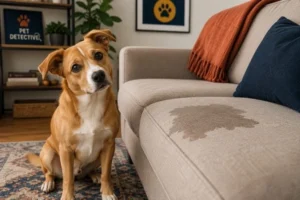
Why is my dog licking the couch?
The answer may be simple: your couch smells like snacks, sweat, another pet, or yesterday’s mysterious crumb festival. But repeated couch licking can also be a clue pointing toward boredom, stress, anxiety, nausea, pain, compulsive behavior, or even a fabric-eating habit that needs veterinary attention.
So grab your magnifying glass and a lint roller. We’re opening the case file.
Pet parent note: This article is for general education and is not a substitute for veterinary care. Contact your veterinarian if your dog’s licking is sudden, excessive, hard to interrupt, or paired with signs of illness, pain, anxiety, or fabric ingestion.
Is It Normal for Dogs to Lick the Couch?
Sometimes, yes. Occasional couch licking can be perfectly ordinary dog behavior.
Dogs investigate the world with their noses and mouths. Your couch may look like furniture to you, but to your dog, it is a giant scent archive. It may hold traces of food, body oils, sweat, pet odors, spilled drinks, cleaning products, or that one microscopic chip crumb your dog has sworn to recover in the name of justice.
The real clue is frequency.
A few licks after movie-night popcorn? Probably not a five-alarm mystery. But if your dog keeps licking the couch every day, leaves wet patches, seems unable to stop, or suddenly starts licking furniture out of nowhere, the investigation needs to go deeper.
Excessive licking can be linked to behavioral concerns such as stress, anxiety, boredom, or compulsive behavior, and it may also appear alongside medical issues such as nausea, pain, allergies, infections, or parasites. (PetMD)
8 Reasons Your Dog May Be Licking the Couch
1. The Couch Tastes or Smells Interesting
First suspect: the couch itself.
Soft furniture collects evidence. Crumbs fall between cushions. People sit, snack, nap, sweat, and spill things. Other pets rub against the fabric. Your dog’s nose may detect a whole buffet of invisible clues.
Your dog may lick the couch because it smells like:
- Food crumbs or grease
- Salty skin residue
- Sweat or body oils
- Another dog or cat
- Old drool
- Spilled drinks
- Treat residue
- Interesting cleaning-product scents

What to do:
Vacuum the couch thoroughly, especially between cushions. Then clean the area with a pet-safe upholstery cleaner that fits your furniture’s care instructions. Avoid harsh fragrances, essential oils, or strong chemical residues, since some products can irritate pets or make the couch even more interesting.
Then watch the evidence: if the licking fades after cleaning, congratulations. The snack-scent suspect has been apprehended.
2. Your Dog Is Bored
A bored dog is a creative dog. Sometimes too creative.
When dogs do not get enough physical activity, mental stimulation, sniffing time, or appropriate chewing outlets, they may invent their own hobbies. Couch licking is not the weirdest hobby in the canine universe, but it is one of the soggier ones.
Boredom-related licking may happen when:
- Your dog is home alone for long stretches
- Your dog has lots of energy but few outlets
- Walks are short or rushed
- Toys are always the same
- Your dog gets attention when they lick the couch
- Your dog is a young, active, or highly curious pup
PetMD notes that obsessive licking can be associated with stress, anxiety, or boredom, and pica-related guidance from AKC emphasizes meeting dogs’ needs for exercise, mental stimulation, attention, and rest. (PetMD)
What to do:
Add enrichment before your dog usually starts licking. Try a puzzle feeder, snuffle mat, scent game, food-stuffed toy, short training session, or a longer sniff walk. For many dogs, sniffing is not a bonus activity. It is detective work.
3. Your Dog Is Stressed or Anxious
Now the plot thickens.
Some dogs lick furniture as a self-soothing behavior when they feel stressed, conflicted, or anxious. Licking may help them calm themselves in the moment, especially if the behavior becomes repetitive or ritual-like. PetMD describes licking as a possible calming or displacement behavior in anxious situations and notes that it can also be involved in compulsive disorders. (PetMD)
Stress-related couch licking may appear after:
- A move
- A new baby
- A new pet
- Guests in the home
- Loud noises
- Thunderstorms or fireworks
- A change in routine
- A family member leaving
- More time alone than usual
- Conflict or tension in the household
Look for the surrounding clues. Does your dog lick the couch when you leave? During storms? At night? When visitors arrive? After a schedule change?

Anxiety does not always look like trembling in a corner. It can look like pacing, whining, panting, barking, clinginess, destructive behavior, house soiling, hiding, or repetitive licking.
What to do:
Track when the couch licking happens. Then look for patterns. For anxiety-related licking, punishment can make stress worse, so focus on calm redirection, predictable routines, safe resting spaces, and support from your veterinarian or a certified behavior professional.
4. Your Dog Finds Licking Comforting
Some dogs lick because it feels good.
The repeated motion may be soothing, especially when a dog is tired, overstimulated, or winding down. What starts as “Hmm, this cushion tastes intriguing” can become “Ah yes, my nightly upholstery meditation.”
Habit-based couch licking may be more likely if:
- It happens at the same time every day
- Your dog looks relaxed rather than frantic
- Your dog stops when redirected
- There are no other symptoms
- The couch has become part of your dog’s settling routine
But even a comforting habit can become a problem if it turns excessive, damages furniture, or prevents your dog from relaxing normally.
What to do:
Redirect before your dog gets fully absorbed in the licking. Offer a dog-safe lick mat, chew, puzzle toy, or calm place to rest. Reward your dog for choosing the alternative. The goal is not to scold the suspect. The goal is to give them a better alibi.
5. Your Dog Feels Nauseous or Has Digestive Discomfort
Sometimes licking surfaces can be connected to tummy trouble.
A dog who feels nauseous may lick their lips, the air, floors, carpets, blankets, or furniture. PetMD notes that air licking can be associated with nausea or gastrointestinal issues, and excessive licking can sometimes signal health or behavioral concerns. (PetMD)
Watch for digestive clues such as:
- Drooling
- Lip licking
- Repeated swallowing
- Grass eating
- Vomiting
- Diarrhea
- Loss of appetite
- Restlessness
- Gagging
- Abdominal discomfort
- Sudden change in behavior
If your dog licks the couch once after dinner and then trots away, that may not mean much. But if the licking is sudden, intense, or paired with digestive symptoms, your veterinarian should take the case.
What to do:
Do not try to diagnose nausea at home. Note when the licking occurs, what your dog ate, and any other symptoms. Call your vet if you notice vomiting, diarrhea, appetite changes, drooling, repeated swallowing, pain, or unusual behavior.
6. Your Dog May Be in Pain or Physically Uncomfortable
Dogs are famously bad at handing us written complaints.
Pain may show up as subtle behavior changes, including restlessness, clinginess, hiding, panting, irritability, sleep changes, appetite changes, or repetitive behaviors. Excessive licking can also be associated with underlying health issues, including pain, allergies, infections, or parasites. (PetMD)
Possible discomfort-related suspects include:
- Dental pain
- Mouth irritation
- Arthritis or joint pain
- Skin itchiness
- Ear discomfort
- Gastrointestinal discomfort
- Injury
- Neurologic changes, less commonly
This does not mean every couch-licking dog is in pain. It means sudden or unusual licking deserves context.
What to do:
If the couch licking started suddenly, your dog seems “off,” or you notice limping, whining, hiding, panting, reduced appetite, trouble getting comfortable, or sensitivity to touch, contact your veterinarian.
The couch may be the crime scene, but the real clue could be somewhere else.
7. Your Dog Has a Compulsive Licking Pattern
Here is where the case moves from quirky to concerning.
Compulsive behavior is repetitive, hard to interrupt, and often continues even when the original trigger is gone. VCA describes compulsive disorders in dogs as repetitive behaviors that may interfere with normal function, and its examples include excessive licking-related conditions. (Vca)
Couch licking may be compulsive if:
- Your dog seems unable to stop
- The licking happens frequently or for long periods
- Redirection barely works
- The behavior returns immediately
- Your dog licks multiple surfaces obsessively
- The licking interferes with sleep, meals, play, or family life
- It worsens during stress
Compulsive behaviors may need long-term management. Depending on the dog, treatment may include environmental changes, behavior modification, reducing stressors, more enrichment, and in some cases medication prescribed by a veterinarian or veterinary behaviorist.
What to do:
Do not punish compulsive licking. Punishment can add stress and may intensify the behavior. Instead, document the pattern and talk to your veterinarian. Ask whether a veterinary behaviorist or certified behavior consultant may be appropriate.
8. Your Dog Is Chewing or Swallowing Fabric
Important plot twist: licking is one thing. Eating the couch is another.
If your dog is licking, chewing, shredding, or swallowing couch fabric, stuffing, threads, or foam, the mystery becomes more urgent.
VCA defines pica as the persistent ingestion of non-food items, including fabric, plastic, paper, sticks, rocks, or mulch. Fabric ingestion can be dangerous because swallowed material may cause choking, stomach upset, or intestinal blockage. (Vca)
Call your veterinarian promptly if your dog may have swallowed couch material, especially if you notice:
- Missing fabric or stuffing
- Vomiting
- Repeated gagging
- Loss of appetite
- Lethargy
- Abdominal pain
- Straining to poop
- Diarrhea or constipation
- Restlessness
- Repeated attempts to vomit
What to do:
Block access to the couch, remove loose fabric or stuffing, and contact your vet. If your dog ate a large amount, seems painful, keeps vomiting, or cannot keep food or water down, seek urgent veterinary care.
When Should You Worry About Couch Licking?
Occasional couch licking may be a misdemeanor. Sudden, intense, symptom-packed couch licking? That case gets bumped to veterinary headquarters.
Contact your veterinarian if:
- The licking starts suddenly and persists
- Your dog seems unable to stop
- Your dog licks the couch for long periods
- Licking is paired with vomiting, diarrhea, drooling, or appetite loss
- Your dog is chewing or swallowing fabric
- You notice signs of pain, anxiety, confusion, or behavior change
- The licking disrupts sleep, meals, play, or normal routines
- Cleaning, enrichment, and redirection do not help
Also call your vet if your gut says, “This is new, weird, and not like my dog.” Pet parents are often excellent witnesses. You know your dog’s normal better than anyone.
How to Stop Your Dog From Licking the Couch
Ready to solve the case? Start with the simplest clues first.
Step 1: Clean the Evidence
Before assuming anxiety, nausea, or a grand conspiracy, clean the couch.
Try this:
- Vacuum cushions, seams, and crevices.
- Remove washable covers and launder them according to care instructions.
- Use a pet-safe upholstery cleaner.
- Avoid strong scents, essential oils, or harsh residues.
- Keep your dog away until the fabric is fully dry.
Then observe. If the licking stops, the couch was probably holding a scent or taste your dog found irresistible.
Case note: crumbs are rarely innocent.
Step 2: Track the Pattern
A good detective never works without notes.
For a week, jot down:
- Time of day
- How long the licking lasts
- What happened right before it started
- Whether your dog had eaten recently
- Whether your dog had exercise that day
- Who was home
- Whether your dog was alone
- Any stress triggers
- Any symptoms like drooling, vomiting, diarrhea, limping, or hiding
- Whether your dog could be redirected
Patterns can reveal the likely suspect. Nighttime licking may point to habit or settling behavior. Licking when alone may point toward separation-related distress. Licking after meals may raise questions about food residue or digestive discomfort.
Step 3: Add More Enrichment
Many couch-licking cases benefit from more appropriate outlets.
Try:
- Sniff walks
- Puzzle feeders
- Snuffle mats
- Food-stuffed toys
- Dog-safe lick mats
- Short training games
- Hide-and-seek with treats
- Rotating toys
- Chews suited to your dog’s size and chewing style
A lick mat can be especially useful because it gives your dog a legal licking assignment. Use dog-safe toppings, supervise your dog, and wash the mat after each use.

Good options may include plain canned pumpkin, wet dog food, or xylitol-free plain yogurt, depending on your dog’s diet and health needs. Check with your vet if your dog has food sensitivities, pancreatitis risk, diabetes, kidney disease, or other dietary restrictions.
Step 4: Redirect, Don’t Punish
When you catch your dog licking the couch, avoid shouting, scolding, or physically forcing them away. That can increase stress or turn couch licking into a guaranteed attention machine.
Instead:
- Calmly interrupt with a cue your dog knows, such as “come” or “touch.”
- Offer an appropriate alternative, like a chew, lick mat, puzzle toy, or dog bed.
- Praise and reward your dog for switching activities.
- Repeat consistently.
The message is simple: “Not the couch, detective. Try this approved evidence bag instead.”
Step 5: Manage Couch Access
While you work on the underlying cause, prevent rehearsals of the behavior.
Try:
- Washable couch covers
- Baby gates
- Closed doors
- A cozy dog bed near the couch
- Supervised couch time
- A chew or puzzle toy before the usual licking hour
Management is not failure. It is crime-scene preservation.
Step 6: Bring in Your Vet When Needed
If couch licking is excessive, sudden, compulsive, or paired with symptoms, your veterinarian can help rule out medical causes.
Bring your case notes. Mention:
- When the licking started
- How often it happens
- Whether your dog licks other surfaces
- Any appetite, stool, vomiting, or behavior changes
- Any signs of pain or anxiety
- Whether your dog chews or swallows fabric
Your vet may recommend an exam, diagnostic testing, diet discussion, pain evaluation, anxiety support, or referral to a veterinary behaviorist.
What Not to Do
In our official detective handbook, the following tactics are marked “suspicious and unhelpful.”
Avoid:
- Punishing your dog for licking
- Using shock collars or fear-based corrections
- Ignoring sudden behavior changes
- Letting your dog chew or swallow fabric
- Spraying strong deterrents without addressing the cause
- Using essential oils or harsh cleaners on furniture
- Assuming all licking is “just weird dog stuff”
- Waiting too long when vomiting, pain, lethargy, or fabric ingestion is involved
The goal is not just to protect the couch. It is to understand what your dog is trying to tell you.
The Couch-Licking Clue Chart
Use this quick case-solving checklist:
|
Clue |
Possible Suspect |
What to Try |
|
Licking happens after snacks or meals |
Food smells or crumbs |
Vacuum and clean the couch |
|
Licking happens when your dog is alone |
Stress or separation-related anxiety |
Track patterns and talk to your vet |
|
Licking happens during storms or noise |
Fear or stress |
Create a calm space and use gentle support |
|
Dog stops easily when redirected |
Habit or mild boredom |
Offer enrichment and reward alternatives |
|
Dog cannot stop licking |
Compulsive behavior or distress |
Contact your vet |
|
Licking comes with drooling or vomiting |
Nausea or GI discomfort |
Call your vet |
|
Dog is chewing or swallowing fabric |
Pica or ingestion risk |
Block access and contact your vet |
|
Dog seems painful or “off” |
Medical discomfort |
Schedule a veterinary exam |
⚠️ When Should You Call the Vet?
Call your veterinarian if the couch licking is sudden, intense, repetitive, difficult to interrupt, or paired with other symptoms. You should also call if your dog is licking multiple surfaces obsessively, drooling, swallowing repeatedly, vomiting, refusing food, acting painful, or trying to eat fabric.
A good rule of thumb: if the behavior feels out of character, investigate. You know your dog’s normal better than anyone. A quirky habit that has existed for years is different from a brand-new behavior that appears overnight.
Note when the licking started, how often it happens, what surfaces your dog licks, what food they eat, any recent diet changes, any cleaning products used, and whether there are other symptoms. These details help your vet separate behavior, stomach discomfort, dental issues, and other medical possibilities.
If your vet rules out medical causes, that is still valuable. It means you can focus confidently on anxiety, boredom, habit training, and environmental management. In detective terms, clearing a suspect is part of solving the case.
The Final Verdict
Your dog may be licking the couch because it smells delicious, salty, familiar, or fascinating. They may also be bored, stressed, anxious, self-soothing, nauseous, uncomfortable, or stuck in a compulsive pattern.
The best next step is to inspect the clues:
Clean the couch. Track when the licking happens. Add enrichment. Redirect calmly. Prevent fabric eating. And call your veterinarian if the behavior is sudden, excessive, hard to interrupt, or paired with symptoms.
The couch may be damp, but the mystery does not have to stay unsolved.
Case closed? Maybe.
Couch dry? We can dream.
FAQs
Why is my dog licking the couch all of a sudden?
Sudden couch licking may happen because your dog smells food, cleaning products, another pet, or something new on the fabric. It can also point to nausea, anxiety, dental discomfort, or another medical issue, especially if the behavior is intense or unusual.
Is it normal for dogs to lick furniture?
Occasional furniture licking can be normal, especially if there are interesting smells or crumbs. Frequent, obsessive, or hard-to-interrupt licking is less normal and should be investigated.
Why does my dog lick the couch at night?
Nighttime couch licking may be linked to habit, boredom, anxiety, or stomach discomfort. If your dog also gulps, drools, paces, or seems unsettled at night, nausea or discomfort may be involved.
Can anxiety cause my dog to lick the couch?
Yes, anxiety can cause dogs to lick surfaces as a self-soothing behavior. This is especially likely if the licking happens during storms, when guests visit, when you leave, or during changes in routine.
Can nausea make my dog lick the couch?
Yes, nausea can cause dogs to lick surfaces, lips, air, or objects. If your dog is also drooling, swallowing repeatedly, refusing food, vomiting, or acting restless, call your veterinarian.
How do I stop my dog from licking the couch?
Start by cleaning the couch, blocking access when unsupervised, and redirecting your dog to a safe licking outlet like a lick mat or food puzzle. If the licking is sudden, obsessive, or paired with symptoms, check with your vet before assuming it is only behavioral.
Is couch licking a sign my dog has pica?
Licking alone is not necessarily pica. But if your dog is chewing, tearing, or swallowing couch fabric, stuffing, or threads, pica-like behavior may be involved and you should contact your veterinarian.
Should I punish my dog for licking the couch?
No, punishment can increase stress and may make the behavior worse. Calmly interrupt, redirect your dog to an approved activity, and address the underlying cause.
What can I put on my couch to stop my dog from licking it?
A washable couch cover or blanket can help while you work on training. Avoid bitter sprays or strong scents unless your vet approves, because some products may irritate your dog or make the couch more interesting.
When should I worry about my dog licking the couch?
Worry if the licking starts suddenly, becomes obsessive, happens with vomiting or appetite changes, or involves eating fabric. Those clues suggest the behavior may be more than a harmless habit.

Become a Junior Pet Detective
Get weekly pet mysteries, behavior clues, recall alerts, and detective-approved recommendations sent straight to your inbox.