
Case File #008
How to Get Cat Pee Smell Out of a Couch Without Ruining It
📝 Case Summary
Case File #008: suspiciously smelly cushion
Pet: Cat
Category: Behavior
Urgency Level: Usually Low
Main Suspects: unknown at this time
Vet Needed?: Sometimes
🔎 Quick Answer
To get cat pee smell out of a couch without ruining it, blot the urine with clean towels, check the upholstery care tag, spot-test a cat-safe enzymatic cleaner, apply enough cleaner to reach the urine, let it sit according to the product label, blot again, and air dry completely. Avoid scrubbing, heat, bleach, ammonia, and soaking the cushion.
Full Case File 📂
How to Get Cat Pee Smell Out of a Couch Without Ruining It
There are household mysteries, and then there is the case of the suspicious smelly couch cushion.
You walk into the room. Your cat looks innocent. Too innocent. Then the evidence hits your nose: unmistakable cat pee smell, lodged somewhere in the couch like a tiny, smelly villain with excellent hiding skills.
The good news: your couch may not be doomed. The best way to get cat pee smell out of a couch without ruining it is to blot first, check the upholstery care tag, spot-test your cleaner, use a cat-safe enzymatic cleaner, avoid heat, and let the couch dry completely.
The less-good news: cat urine can travel deeper than it looks, especially into cushion foam. So this investigation needs patience, not panic.
Let’s crack the case.
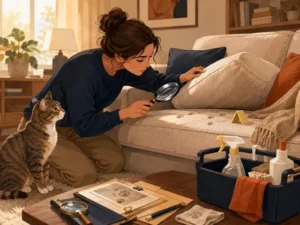
First, Check the Couch Care Tag
Before you charge into the crime scene with a spray bottle, inspect the couch care tag. This little label is your first clue because not every fabric can handle water, vinegar, or upholstery cleaner.
Most couch tags use cleaning codes:
|
Code |
What It Usually Means |
|
W |
Water-based cleaners may be used. |
|
S |
Solvent-based cleaners only. Avoid water-based cleaning. |
|
WS or W/S |
Water-based or solvent-based cleaners may be allowed. |
|
X |
Vacuum only. Do not use liquid cleaners; call a professional. |
Even if the tag says water-based cleaning is allowed, always spot-test your cleaner on a hidden area first. Wait until the test spot dries before treating the urine area. The true suspect may be cat pee, but upholstery damage is the accomplice we are trying to avoid.
What You’ll Need to Remove Cat Pee Smell From a Couch
Gather your evidence kit:
- Clean white cloths or paper towels
- Disposable gloves
- Cat-specific enzymatic cleaner
- Baking soda
- Vacuum
- Cool water, only if the fabric allows it
- Blacklight flashlight, optional
- Fan
- Wet/dry vacuum or upholstery extractor, optional
- Waterproof cover or washable throw for prevention
The most important item is the enzymatic cleaner. Cat urine smell is not just a surface-level odor. Enzyme cleaners are designed to break down urine components rather than simply cover the smell with fragrance.
How to Get Fresh Cat Pee Smell Out of a Couch
Fresh cat pee is the best-case scenario. Not a pleasant case, but a solvable one. Move quickly before the urine travels deeper into the upholstery or cushion foam.
Step 1: Blot, Don’t Scrub
Put on gloves and blot the area with clean white cloths or paper towels.
Press firmly. Lift. Replace the cloth. Repeat.
Do not scrub. Scrubbing can push urine deeper into the fabric and spread the stain. In detective terms, that is tampering with the evidence.
Step 2: Remove Cushion Covers, If Possible
If your couch has removable cushion covers, unzip them and check the care label.
Do not toss the cover into the washing machine unless the label says it is safe. Some couch covers shrink, fade, or lose shape when machine-washed.
If the urine reached the cushion insert, remember this clue: cleaning the cover alone will not solve the smell.
Step 3: Rinse Lightly With Cool Water, If Fabric-Safe
If your upholstery tag allows water-based cleaning, lightly dampen the area with cool water and blot again.
Use as little water as possible. The goal is to dilute and lift some urine, not soak the couch into a swampy second crime scene.
Skip this step for leather, “S” code fabrics, “X” code fabrics, delicate upholstery, or any material that reacts poorly to water.
Step 4: Apply a Cat-Safe Enzymatic Cleaner
Spray or pour the enzymatic cleaner according to the product directions.
Here is the key clue: the cleaner needs to reach wherever the urine reached. If urine soaked below the fabric, a tiny surface mist will not be enough. But you also do not want to flood the couch.
Follow the label’s dwell time. Many enzymatic cleaners need to stay damp for a period of time so the enzymes can work.
Step 5: Blot Again
After the recommended dwell time, blot the area with clean towels.
Do not rub. Do not attack the cushion like you are interrogating it under a desk lamp. Firm, patient blotting is the move.
Step 6: Air Dry Completely
Let the couch air dry with good ventilation. Use a fan if possible.
Avoid hair dryers, steam cleaners, heaters, or direct high heat. Heat can make urine odor harder to remove and may damage upholstery.
Step 7: Use Baking Soda After the Area Is Dry
Once the area is fully dry, sprinkle baking soda over the spot. Let it sit for several hours or overnight, then vacuum thoroughly.
Important case note: baking soda can help absorb lingering odor, but it does not replace an enzymatic cleaner for cat urine.
How to Remove Dried Cat Pee Smell From a Couch
Old cat pee is trickier because dried urine can hide in fabric, batting, foam, seams, or cushion inserts. The smell may seem to disappear and then return on a humid day like a villain in the sequel.
Step 1: Find the Full Odor Source
Use your nose first. Then, if needed, use a blacklight flashlight in a dark room to locate dried urine spots.
The visible stain may be smaller than the actual urine area. Treat the full affected zone, not just the center of the spot.
Step 2: Lightly Rehydrate the Area With Enzymatic Cleaner
Dried urine residue may need to be reactivated so the cleaner can reach it. Use the enzymatic cleaner according to the label, applying enough to contact the odor source.
Avoid soaking the couch. Too much liquid can create water stains, mildew risk, or deeper cushion problems.
Step 3: Let the Cleaner Work
Follow the dwell time listed on the cleaner. Some products need more time on older stains.
You may need to keep the area slightly damp for the recommended period. Some product labels suggest covering the area loosely with plastic wrap during dwell time, but only do this if the cleaner’s instructions recommend it and your fabric can tolerate it.
Step 4: Blot and Dry Thoroughly
Blot with clean towels. Then air dry completely with a fan.
Do not judge the results while the couch is still damp. Wet fabric can smell different, and trapped moisture may confuse the investigation.
Step 5: Repeat If Needed
Old cat urine may need more than one enzymatic treatment.
If the smell improves but does not disappear, repeat the process after the couch fully dries. If the smell does not improve at all, the urine may have soaked into foam, batting, or the couch frame.
What Not to Use on Cat Pee Smell
Some cleaning suspects look helpful at first, then betray you.
Don’t Use Ammonia
Avoid ammonia-based cleaners. Cat urine can have an ammonia-like smell, and using ammonia may make the area smell more like a bathroom spot to your cat.
Don’t Use Bleach on Upholstery
Bleach can discolor fabric, damage fibers, and create safety concerns if misused around pets. It is not a couch-friendly solution for cat urine.
Don’t Use Steam or Heat First
Steam sounds powerful, but heat can make urine odor more stubborn. Always start with blotting and enzymatic cleaning.
Be Careful With Vinegar
Vinegar is a popular home-cleaning suggestion, but it is not the best answer for every couch. It can leave its own smell, damage certain upholstery, and may not fully break down cat urine odor.
If you use vinegar on a water-safe fabric, spot-test first and use it cautiously. For most cat urine couch cases, a cat-specific enzymatic cleaner is the stronger lead.
Don’t Soak the Couch
More liquid does not mean more clean. Oversoaking can push urine deeper, create water rings, slow drying, and increase the risk of musty smells.
How to Clean Cat Pee From Different Couch Materials
Different couches leave different clues. Your cleaning method should match the material.
Fabric Couch
For most water-safe fabric couches, blot first, apply an enzymatic cleaner, follow dwell time, blot again, and air dry.
Watch for water rings. If the fabric stains easily, clean the entire cushion panel lightly rather than only one tiny spot, or call a professional.
Microfiber Couch
Microfiber can be sensitive to water marks depending on its cleaning code.
Check the tag. If water-based cleaning is allowed, use minimal moisture and blot carefully. After drying, gently brush the nap with a soft brush if the fabric looks stiff or flattened.
Leather Couch
Leather needs a gentler investigation.
Blot immediately. Do not soak. Use a leather-safe cleaner and follow with a leather conditioner if appropriate for your couch.
If urine entered seams, stitching, or cushion filling, the odor may be difficult to remove without professional help.
Couch Cushion Foam
Cushion foam is often the hidden culprit.
If the cover smells clean but the couch still reeks, urine may have reached the foam insert. Apply enzymatic cleaner carefully so it reaches the affected area, then dry thoroughly.
For severe saturation, cushion replacement may be more realistic than endless cleaning.
Why Cat Pee Smell Comes Back
You cleaned. You waited. You sniffed. Victory seemed near.
Then the smell returned.
Here are the usual suspects:
|
Problem |
Likely Cause |
What to Try |
|
Smell returns after drying |
Urine reached foam or batting |
Repeat enzyme treatment; dry longer |
|
Smell gets worse in humidity |
Dried urine residue reactivated |
Locate full stain and retreat |
|
Couch has water rings |
Fabric reacted to moisture |
Use less liquid; consider professional cleaning |
|
Odor remains after cleaning cover |
Cushion insert is contaminated |
Treat or replace cushion foam |
|
Cat pees there again |
Odor remains or root cause continues |
Re-clean, block access, investigate medical/litter box causes |
A returning smell does not mean you failed. It means the case has moved below the surface.
Why Did Your Cat Pee on the Couch?
Now we leave the upholstery lab and interview the prime suspect.
Cats do not pee on couches out of revenge. Inappropriate urination can be connected to medical discomfort, litter box problems, stress, territorial behavior, or household changes.
Cornell Feline Health Center notes that medical conditions affecting urination can cause litter box problems, including urinary tract inflammation that makes urination painful or more urgent. A cat may then avoid the litter box if they associate it with discomfort. (Cornell Vet College)
The ASPCA also explains that feline interstitial cystitis can lead to urinating outside the litter box because of pain and urgency. (ASPCA)
Investigate the Litter Box Setup
If your cat is medically cleared, inspect the litter box situation.
Common clues include:
- The box is not scooped often enough.
- There are not enough boxes for the number of cats.
- The box is in a loud, busy, or hard-to-reach area.
- Your cat dislikes the litter texture or scent.
- A covered box traps odor or makes the cat feel cornered.
- Another pet is guarding or ambushing the box.
- Household stress has changed the cat’s routine.
VCA Hospitals explains that inappropriate elimination can involve medical or behavioral factors, and behavioral causes may include toileting preferences or communication-related behaviors. (Vca)
A helpful rule of paw: provide one litter box per cat, plus one extra, placed in accessible, low-stress areas.
How to Stop Your Cat From Peeing on the Couch Again
Cleaning the couch is only half the mystery. Prevention solves the sequel.
Block Access While the Couch Dries
Until the couch is fully clean and dry, keep your cat away from it. Close the room, use a temporary waterproof cover, or place a washable blanket over the area.
If any urine odor remains, your cat may return to the same spot.
Make the Litter Box More Inviting
Try:
- Scooping daily, ideally more often in multi-cat homes
- Washing boxes regularly with mild, unscented soap
- Using unscented litter
- Offering a large, uncovered box
- Placing boxes away from loud appliances
- Adding boxes in different parts of the home
Reduce Stress Clues
Cats are creatures of routine. New pets, outdoor cats near windows, moving furniture, schedule changes, visitors, or conflict with another cat can all contribute to inappropriate urination.
Support your cat with predictable routines, vertical spaces, scratching posts, play sessions, and calm resting areas.
Avoid Punishment
Do not yell, rub your cat’s nose in the spot, or punish them after the fact. Punishment can increase stress and does not teach your cat where to pee.
Instead, clean thoroughly, restrict access temporarily, improve the litter box setup, and speak with your veterinarian if the behavior continues.
When to Call a Professional Cleaner
Bring in a professional if:
- The couch care tag says S or X
- The couch is leather, velvet, silk, wool, vintage, or expensive
- Urine soaked into the cushion foam or frame
- The odor remains after several enzyme treatments
- There are water rings, discoloration, or mildew smells
- The couch is under warranty and DIY cleaning could void coverage
A professional upholstery cleaner may not save every cushion, but they can help prevent accidental damage from over-cleaning.
When to Replace the Cushion
Sometimes the final verdict is not “clean again.” It is “replace the evidence.”
Consider replacing the cushion insert if:
- The foam is heavily saturated
- The smell returns after repeated enzyme treatments
- The cushion stays musty
- The cover is clean but the insert still smells
- Your cat repeatedly targets the same cushion
Replacing one cushion insert is often cheaper, easier, and less frustrating than trying to rescue deeply contaminated foam.
The Cat Pee Couch Case: Do This, Not That
|
Do This |
Not That |
|
Blot immediately |
Scrub the stain |
|
Check the couch care tag |
Assume every fabric is washable |
|
Spot-test cleaner |
Spray the whole cushion blindly |
|
Use enzymatic cleaner |
Use perfume or odor spray only |
|
Air dry fully |
Use heat or steam first |
|
Treat the root cause |
Assume your cat is being spiteful |
|
Call the vet for urinary red flags |
Wait if your cat is straining to pee |
⚠️ When Should You Call the Vet?
Call your veterinarian if the couch peeing is sudden, repeated, or paired with any of these signs:
- Straining to urinate
- Crying while urinating
- Frequent trips to the litter box
- Producing only small amounts of urine
- Blood in the urine
- Excessive licking of the genital area
- Hiding, lethargy, vomiting, or appetite changes
Cornell lists difficult or painful urination, increased frequency, crying while urinating, blood in the urine, inappropriate urination, and frequent genital licking as common signs of feline lower urinary tract disease. (Cornell Vet College)
A male cat who is straining and producing little or no urine needs urgent veterinary attention. The ASPCA describes urinary blockage as a life-threatening emergency. (ASPCA)
The Final Verdict
In many cases, yes. You can get cat pee smell out of a couch without ruining it if you work carefully and follow the clues.
Start by blotting. Check the care tag. Use a cat-safe enzymatic cleaner. Avoid ammonia, bleach, heat, and oversoaking. Let the couch dry completely. If the smell comes back, investigate the cushion foam. And if your cat keeps peeing outside the litter box, look beyond the couch—medical discomfort, stress, or litter box issues may be part of the case.
The couch may be the scene of the crime, but your cat’s behavior is the clue worth following.
Case status: solvable, with patience.
FAQs
Can cat pee smell be removed from a couch completely?
Often, yes. Fresh urine is usually easier to remove than dried urine. If cat pee soaked deep into cushion foam, batting, or the couch frame, complete odor removal may require repeated enzymatic treatments, professional cleaning, or cushion replacement.
What is the best cleaner for cat pee on a couch?
A cat-specific enzymatic cleaner is usually the best choice because it is designed to break down urine odor rather than simply mask it. Always check your couch care tag and spot-test first.
Can I use vinegar to remove cat pee smell from a couch?
Vinegar may help with some odors, but it is not ideal for every upholstery type and may not fully remove cat urine smell. It can also leave a vinegar odor or damage sensitive fabrics. Spot-test first and consider an enzymatic cleaner instead.
Why does my couch still smell like cat pee after cleaning?
The urine may have soaked into the cushion foam, the cleaner may not have reached the full stain, or the couch may not be fully dry. Old urine stains may need multiple enzymatic treatments.
Can I use baking soda on cat pee?
Yes, but only as a supporting step. Baking soda can help absorb lingering odor after the area is cleaned and dry. It should not replace enzymatic cleaner for cat urine.
Should I steam clean cat pee on a couch?
Avoid steam or heat as the first step. Heat can make urine odor harder to remove and may damage upholstery. Start with blotting and enzymatic cleaner.
Why is my cat peeing on the couch?
Possible causes include urinary discomfort, litter box problems, stress, territorial behavior, or changes in the household. Sudden or repeated couch peeing should be discussed with a veterinarian, especially if your cat shows signs of pain, straining, frequent urination, or blood in the urine.
Become a Junior Pet Detective
Get weekly pet mysteries, behavior clues, recall alerts, and detective-approved recommendations sent straight to your inbox.