
Case File #012
Slow Feeder Bowls for Flat-faced Dogs
📝 Case Summary
Case File #012: World's fastest eating dog finally stumped
Pet: Dogs
Category: Slow Feeders
Importancy Level: Dependent on situation
Main Suspects: TBD
Full Case File 📂
Slow Feeder Bowls for Flat-Faced Dogs: How to Choose One That Actually Works
Dinner disappears in twelve seconds. The bowl skids halfway across the kitchen. Your Frenchie looks delighted with their own efficiency—and then looks personally betrayed when a deep maze feeder turns supper into an impossible obstacle course.
Slow feeder bowls can be a useful tool for dogs that gulp meals, but flat-faced dogs need a little extra consideration. French Bulldogs, Pugs, English Bulldogs, Boston Terriers, Shih Tzus, and other short-snouted pups may find some standard slow feeders difficult to use, especially designs with deep pockets, tall ridges, or narrow channels.
The goal is not to make dinner as challenging as possible. The goal is to help your dog eat at a more measured pace with a bowl they can comfortably navigate.
Case file opened.
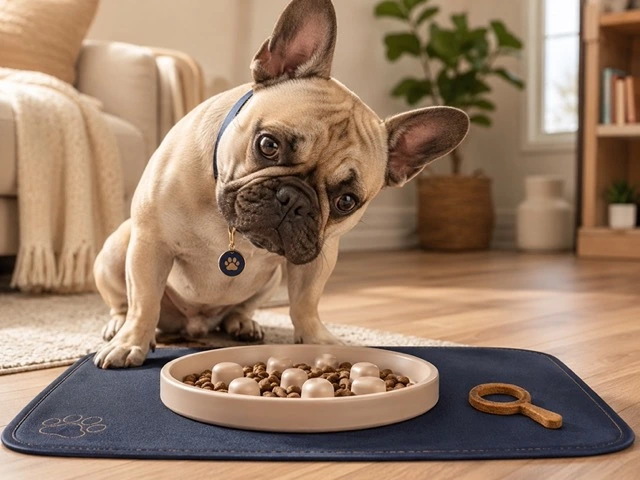
Can Flat-Faced Dogs Use Slow Feeder Bowls?
Yes—many flat-faced dogs can use slow feeder bowls successfully.
The best slow feeder for a short-snouted dog is usually one with shallow grooves, low ridges, wide channels, and a stable base. Those features help spread food out without requiring your dog to reach deep into a complicated maze.
Slow-feed bowls are designed with raised sections that slow access to food, and they can add a little problem-solving enrichment to a meal. Veterinary and pet-health resources commonly recommend slow feeders, meal-based training, or smaller portions as options for dogs that eat too fast. (Vca)
But there is an important clue to keep in mind: a slow feeder should slow your dog down, not prevent them from eating comfortably. If your dog cannot reach the food, repeatedly flips the bowl, paws frantically, walks away from meals, coughs, or appears distressed, the feeder may be the wrong shape or difficulty level.
For dogs with known breathing concerns, swallowing problems, repeated vomiting or regurgitation, or other feeding difficulties, it is wise to speak with a veterinarian before making mealtime changes. Brachycephalic dogs can have airway-related challenges because of their anatomy, so individualized guidance matters. (Vca)
Why Standard Slow Feeders Can Be Tricky for Short-Snouted Dogs
Not all slow feeders are built with a Pug nose, Bulldog jowls, or Frenchie face in mind.
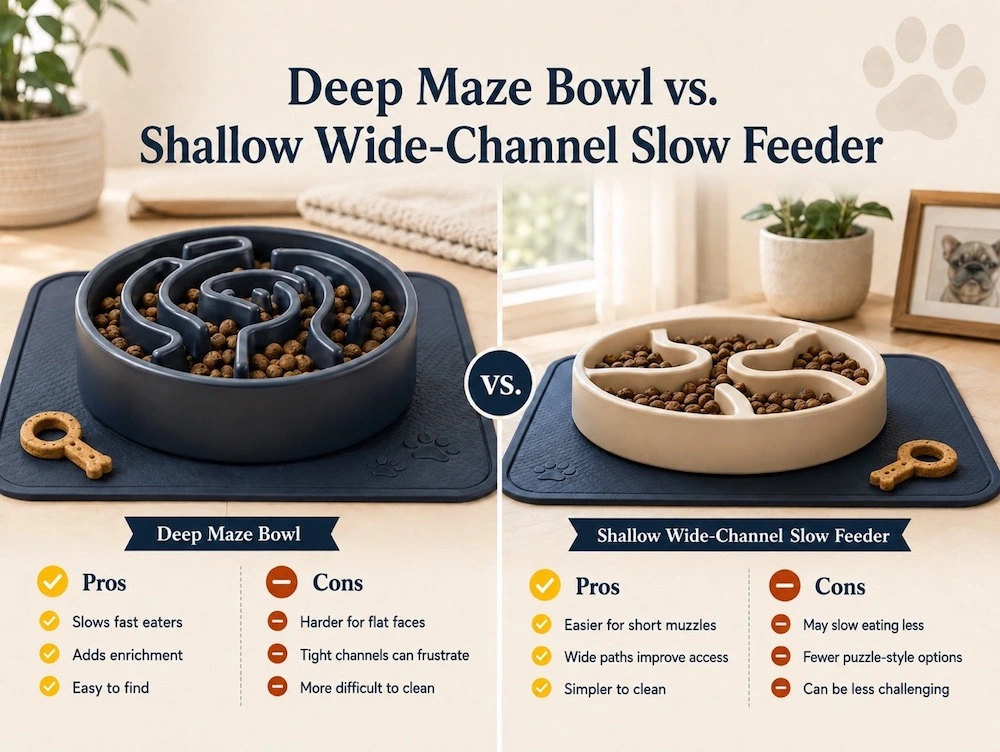
Deep grooves can put food out of reach
A deep maze bowl may work well for a long-muzzled dog who can easily nose into narrow pathways. A flatter-faced dog may have more trouble reaching kibble at the bottom of those channels.
That does not mean every maze bowl is off-limits. It simply means the bowl’s design matters more than the marketing label. “Slow feeder” is a category, not a guarantee of a good fit.
Tight patterns can create frustration
A feeder should create a manageable challenge. Your dog may need to lick, nudge, or work around low ridges—but they should still be able to access most of the meal without turning dinner into a full-contact sport.
A little effort is expected. Repeated bowl flipping, hard pawing, barking at the bowl, or abandoning food are stronger clues that the design is too difficult.
Wet food changes the investigation
Kibble can roll around a feeder’s channels. Wet food, rehydrated food, toppers, and mixed meals behave differently.
For these meals, a low-profile lick mat, shallow tray, or feeder with broad ridges is often more practical than a deep plastic labyrinth. You want a surface that spreads food out—not a collection of hidden pockets that are hard to clean.
Fast eating is worth addressing—but not with panic
Eating too quickly can be associated with choking, vomiting, and discomfort. It is also listed among risk factors for gastric dilatation-volvulus, or GDV, although GDV is most commonly associated with large, deep-chested dogs and has multiple risk factors. (American Kennel Club)
That is why it is best to treat fast eating as a habit worth investigating rather than a reason to buy the most difficult bowl on the shelf.
What to Look for in a Slow Feeder Bowl for Flat-Faced Dogs
Here is the evidence board: the features most likely to make a slow feeder workable for a short-snouted dog.
1. Shallow grooves and low ridges
This is the headline clue.
Look for a feeder where food stays near the surface rather than disappearing into deep trenches. Low, rounded ridges let your dog work around the food while keeping it reachable.
Skip designs that resemble a miniature mountain range unless your dog has already shown they can comfortably use them.
2. Wide channels and open patterns
Broad spirals, open loops, gentle waves, and large compartments are usually a better starting point than dense maze patterns.
A good question to ask before buying: Could my dog’s tongue and nose reasonably reach the food across this surface?
If the answer is “only with an engineering degree,” move along, detective.
3. A stable, non-slip base
Fast eaters may push a lightweight bowl around while trying to get every last crumb. Look for a non-slip base, a heavier bowl, suction features, or a feeder that fits securely inside a stable dish.
A bowl that remains in place can make meals less chaotic for both dog and human.
4. The right size for your dog’s face and portion
Check the usable eating surface—not just the overall bowl diameter.
A tiny feeder may be technically appropriate for a small dog’s food portion but still be too cramped for their face. Conversely, an oversized bowl can spread a small meal so thinly that it becomes frustrating or impractical.
Measure your dog’s typical food portion, compare product dimensions, and consider their muzzle width. Breed labels can be helpful, but they are not a perfect fit guide.
5. Food compatibility
Choose the feeder based on what your dog actually eats.
|
Meal Type |
Usually a Good Starting Option |
Watch For |
|
Dry kibble |
Shallow spiral bowl or wide-channel dish |
Deep pockets that trap kibble |
|
Wet food |
Lick mat or low-ridge feeder tray |
Hard-to-clean crevices |
|
Mixed meals |
Broad-pattern slow feeder |
Food becoming inaccessible in tight corners |
|
Rehydrated kibble |
Shallow feeder or lick mat |
Messy overflow from shallow rims |
|
Frozen enrichment |
Freezer-safe lick mat or enrichment tray |
Chewing or tearing silicone |
6. Easy cleaning
A slow feeder has more surfaces than a plain bowl. Those ridges, channels, and corners need regular cleaning—especially after wet food or raw food meals.
Veterinary literature notes that pet food and water bowls should be washed with hot, soapy water at regular intervals to reduce surface contamination. (AVMA Journals)
Choose a bowl you can actually clean thoroughly. Dishwasher-safe can be useful, but always follow the manufacturer’s instructions. A “clever” feeder with impossible-to-reach corners may not be clever after three days of canned food residue.
7. Durable, pet-safe material
Common slow-feeder materials include plastic, silicone, stainless steel, and ceramic. Each has tradeoffs:
- Silicone: Flexible, often useful for wet food and freezing; inspect it regularly if your dog tends to chew.
- Plastic: Lightweight and widely available; replace it if it becomes deeply scratched, cracked, or difficult to sanitize.
- Stainless steel: Durable and easy to clean; slow-feeder inserts may offer more options than full stainless-steel maze bowls.
- Ceramic: Heavier and often stable, but it can chip or break.
The right material is the one that suits your dog’s eating style, your meal routine, and your ability to keep it clean.
Best Types of Slow Feeders for French Bulldogs, Pugs, and Other Flat-Faced Dogs
Rather than hunting for one magic bowl, start by choosing the right category.
Shallow spiral bowls
Best for: Dogs who eat dry kibble quickly and are new to slow feeders.
A shallow spiral can slow the meal by spreading kibble around a low, circular pathway. This is often a more approachable first feeder than a deep maze with narrow pockets.
Look for rounded ridges and enough open space for your dog to access food from different angles.
Wide-channel feeder trays
Best for: Flat-faced dogs who become frustrated with standard maze bowls.
These designs usually have bigger sections and lower barriers. They can be a good middle ground: more challenging than a plain bowl, but less demanding than a puzzle feeder.
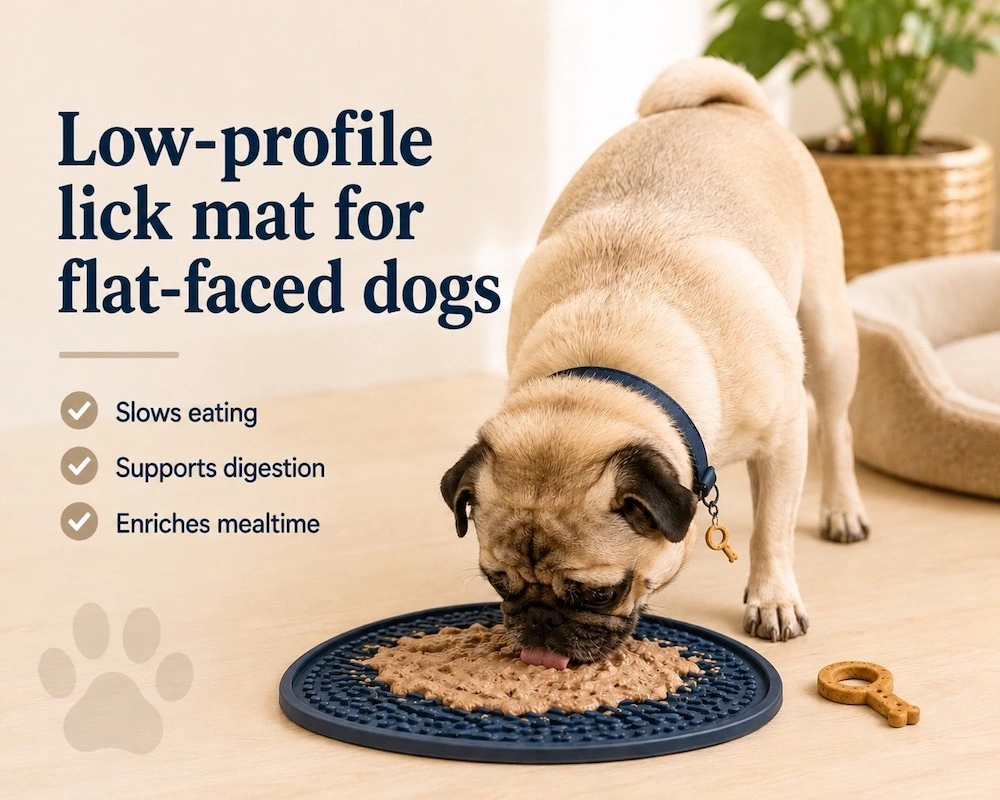
Low-profile lick mats
Best for: Wet food, spreadable meals, softened kibble, and enrichment.
Lick mats can work well when the food can be spread in a thin layer. They are especially handy for dogs who find it easier to lick food from a surface than to retrieve it from a deep bowl.
Supervise use at first, particularly with dogs that chew or shred silicone items.
Slow-feeder inserts
Best for: Pet parents who already have a preferred bowl.
Some inserts sit inside a regular bowl and create a simple barrier. This can be useful when you want to keep a stable stainless-steel or ceramic dish while adding a modest slow-feeding challenge.
Check that the insert fits securely and does not create sharp edges, loose pieces, or a gap that traps food.
Elevated feeding setups
Best for: Dogs whose veterinarian has recommended a specific feeding height or setup.
Do not assume an elevated bowl is automatically better for every dog. The relationship between bowl height and feeding safety is not simple; Cornell’s canine-health guidance lists raised food bowls among several GDV risk factors, alongside factors such as deep chest shape, large meal size, and fast eating. (Cornell Vet College)
For a dog with airway, orthopedic, swallowing, or digestive concerns, ask your veterinarian what feeding position makes sense for that individual dog.
How to Choose the Right Slow Feeder for Your Dog
Use this quick case-file checklist before checkout.
Choose a bowl with:
- Low, smooth barriers instead of tall walls
- Wide, open food channels
- A feeding surface that matches your dog’s muzzle size
- A non-slip base or sturdy bowl design
- A pattern suitable for your dog’s food type
- A cleaning method you can maintain consistently
- A difficulty level that feels achievable, not aggravating
Here is a simple match-up guide:
|
Your Dog’s Situation |
Best First Option |
|
Gulps dry kibble |
Shallow spiral bowl |
|
Eats mostly wet food |
Low-profile lick mat |
|
Has a very short muzzle |
Broad, shallow tray or open-pattern bowl |
|
Pushes bowls across the floor |
Weighted feeder or non-slip base |
|
Gets frustrated easily |
Simplest low-ridge design |
|
Chews silicone |
Durable hard-sided feeder or supervised insert |
|
Eats a mixed meal |
Wide-channel slow feeder with easy-clean ridges |
How to Introduce a Slow Feeder Without Creating Mealtime Frustration
The smoothest introduction is rarely dramatic.
Start with an easy pattern, use a normal portion of food, and observe your dog for the first few meals. You do not need to make the feeder difficult on day one. The goal is a calmer pace, not an Olympic event.
Try this approach:
- Start with a simple feeder. Use low ridges or broad channels before graduating to more complex patterns.
- Spread food thinly. Especially for wet food, keep the layer accessible rather than packing it deep into grooves.
- Use part of the regular meal. This reduces the pressure if your dog needs time to learn the new setup.
- Supervise at first. Watch how your dog uses the feeder, rather than assuming the label tells the whole story.
- Adjust based on the evidence. A relaxed dog who takes longer to eat is a promising result. A dog who flips the bowl and storms off? That bowl may be the culprit.
Meal-based training is another useful option for dogs who eat dry food quickly. VCA notes that feeding some kibble during training sessions can help slow eating while giving your dog attention and engagement. (Vca)
Slow Feeder Safety Tips for Flat-Faced Dogs
Slow feeders can be useful, but they are not a substitute for veterinary care when there is an underlying feeding, breathing, or digestive problem.
Keep these safety notes in the file:
- Supervise your dog when introducing a new feeder.
- Inspect bowls and mats for cracks, deep scratches, loose pieces, or damage.
- Clean the feeder thoroughly after each use, especially after wet, raw, or fresh food.
- Avoid adding random household objects to a bowl unless your veterinarian specifically recommends it; poorly chosen objects can create a choking or ingestion hazard.
- Stop using the feeder if your dog repeatedly coughs, chokes, gags, vomits, refuses food, or appears distressed.
- Contact a veterinarian promptly if feeding problems are persistent or accompanied by breathing difficulty, lethargy, repeated vomiting, or other signs of illness.
Dogs with esophageal problems may show signs such as drooling, coughing, vomiting, neck stretching, or refusing food; these signs deserve veterinary attention rather than a DIY bowl adjustment. (American Kennel Club)
Common Slow Feeder Mistakes to Avoid
Choosing the hardest maze first
A difficult feeder is not automatically a better feeder. Start simple, then only increase complexity if your dog is comfortable and still needs a slower pace.
Buying by breed label alone
“French Bulldog bowl” can be a useful search term, but it does not replace checking dimensions, ridge height, groove width, and product photos.
Using a feeder that is too small
A small feeder can be cramped for a broad-headed Pug or Bulldog, even when the food portion is modest.
Overfilling the bowl
Packing food deep into channels defeats the purpose of choosing a shallow feeder. Keep food accessible.
Ignoring frustration
Your dog’s behavior is the report from the field. If the feeder creates stress, it is not the right fit.
Forgetting the cleaning routine
A bowl that takes twenty minutes to clean every day may quietly retire itself to the back of the cupboard. Choose a design you will realistically maintain.
The Final Verdict
The best slow feeder bowl for a flat-faced dog is not necessarily the most complicated one. It is the one that slows the meal while letting your dog eat comfortably and confidently.
For Frenchies, Pugs, Bulldogs, and other short-snouted dogs, the strongest clues are usually simple: shallow grooves, wide channels, low barriers, steady footing, and an easy-clean design.
A calmer dinner is the solved mystery. The bowl does not need to be dramatic to do its job.
FAQs
Are slow feeder bowls safe for French Bulldogs?
Many French Bulldogs can use a properly sized, shallow slow feeder. Look for low ridges and wide channels, then supervise the first several meals to make sure your dog can access food comfortably. Dogs with known airway, swallowing, or feeding concerns should have individualized veterinary guidance. (Vca)
What is the best slow feeder for a Pug?
A shallow spiral bowl, broad feeder tray, or low-profile lick mat is often a practical place to start. The best choice depends on your Pug’s muzzle shape, meal type, and tolerance for food puzzles.
Can English Bulldogs use maze bowls?
Some can, but a deep or narrow maze bowl may be harder for a short-snouted dog to use. Begin with an open, low-ridge feeder rather than a high-walled maze.
Are lick mats good for flat-faced dogs?
Lick mats can be useful for wet food, spreadable meals, and enrichment because food stays close to the surface. Choose a durable mat, clean it thoroughly, and supervise dogs that may chew the material.
How do I know whether my dog’s slow feeder is too difficult?
Signs include repeated pawing, flipping the bowl, barking at it, leaving food behind because it is unreachable, refusing meals, or showing distress. A suitable slow feeder should encourage a slower pace without making your dog give up.
Can I put wet food in a slow feeder bowl?
Yes. Choose a shallow feeder, tray, or lick mat designed for wet food and easy cleaning. Avoid narrow, deep channels that trap food.

Become a Junior Pet Detective
Get weekly pet mysteries, behavior clues, recall alerts, and detective-approved recommendations sent straight to your inbox.