
Case File #009
How to Teach “Leave It” to a Dog: A Step-by-Step Guide
📝 Case Summary
Case File #009: the leave it method
Pet: Dog
Category: Training
Urgency Level: non-urgent but wise
Main Suspects: attitude, challenger
Vet Needed?: no, but maybe training.
🔎 Quick Answer
Dogs may lick the couch because of food smells, boredom, anxiety, nausea, compulsive behavior, or because they enjoy the texture. Occasional couch licking is often harmless, but frequent or obsessive licking can be a clue worth investigating.
Full Case File 📂
How to Teach “Leave It” to a Dog: A Step-by-Step Training Guide
The case begins with a suspicious object on the floor.
Maybe it is a dropped chicken bone. Maybe it is a sock, a snack wrapper, a runaway pill, or one of those mysterious sidewalk treasures only a dog’s nose could love. Your dog spots it. Their ears perk. The investigation begins.
And suddenly, you have approximately half a second to stop a full-mouth evidence collection.
That is where “leave it” becomes more than a cute trick. It is a practical safety cue that tells your dog: do not touch that — check in with me instead.
Learning how to teach “leave it” to a dog can help with impulse control, safer walks, and better everyday manners. With positive reinforcement, short practice sessions, and a few carefully staged clues, you can teach your dog that ignoring temptation often leads to something even better.
Let’s open the case file.
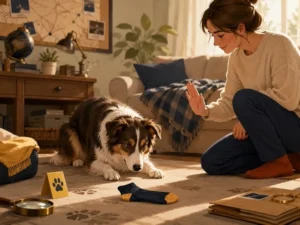
What Does “Leave It” Mean for Dogs?
“Leave it” means your dog should disengage from something before they touch, eat, chase, sniff, grab, or interact with it.
You might use “leave it” when your dog notices:
- Food on the floor
- Trash on a walk
- Another dog’s toy
- A child’s stuffed animal
- Medication
- Wildlife
- Shoes, socks, or laundry
- Something sharp, toxic, or unknown
At its heart, “leave it” is an impulse-control cue. Your dog notices something interesting, but instead of launching a full investigation, they learn to pause, back away, and look to you.
Think of it as the “case closed” cue. The evidence may be fascinating, but your dog does not need to collect it with their mouth.
“Leave It” vs. “Drop It”: What’s the Difference?
These two cues are related, but they are not the same.
|
Cue |
What It Means |
When to Use It |
|
Leave it |
Do not touch or engage with that item |
Before your dog grabs something |
|
Drop it |
Release what is already in your mouth |
After your dog has picked something up |
Use “leave it” when the item is still out of your dog’s mouth. Use “drop it” when your dog already has the item.
For safety, it is helpful to teach both. A reliable “leave it” can prevent trouble, while “drop it” gives you a backup plan when your dog has already snatched the evidence.
Why Positive Reinforcement Works Best
Dogs repeat behaviors that work for them. If grabbing sidewalk snacks works, they may keep doing it. But if looking away from the sidewalk snack earns chicken, praise, and happy human energy, that new choice starts to look like a much better deal.
That is the heart of positive reinforcement: reward the behavior you want so your dog is more likely to repeat it.
The goal is not to scare your dog away from objects. The goal is to teach them that checking in with you is rewarding.
No shouting. No grabbing. No dramatic courtroom objections.
Just clear clues, good timing, and rewards your dog actually cares about.
Supplies You’ll Need
Before training begins, gather your detective kit:
- Small, soft training treats
- A lower-value treat or piece of kibble for the “leave it” item
- A higher-value treat for the reward
- A quiet, low-distraction room
- Optional clicker, or a marker word like “yes”
- A leash for later outdoor practice
Use safe training items only. Never practice with medication, cooked bones, chocolate, grapes, raisins, sharp objects, toxic foods, or anything your dog could swallow by accident.
The first rule of the “leave it” investigation: do not plant dangerous evidence.
How to Teach “Leave It” to a Dog in 6 Steps
Step 1: Start With a Treat in Your Closed Hand
Begin in a quiet room where your dog can focus.
Place a low-value treat or piece of kibble in your closed fist. Let your dog sniff your hand. They may lick, paw, nudge, or stare at it. That is normal. They are gathering clues.
Keep your hand closed and still. Do not yank it away. Do not scold.
The moment your dog backs off, looks away, pauses, or stops trying to get the treat, mark the behavior with “yes” or a click. Then reward them with a better treat from your other hand.
Important: Your dog does not get the treat they were told to leave. They get a different reward.
This teaches a powerful lesson: leaving the forbidden item does not mean the fun is over. It means something better may happen.
Step 2: Add the Verbal Cue
Once your dog understands the basic game, add the words “leave it.”
Hold the treat in your closed fist. As your dog notices your hand, calmly say:
“Leave it.”
Say it once. Then wait.
When your dog backs away, looks away, or checks in with you, mark and reward from your other hand.
Avoid repeating “leave it, leave it, leave it.” Repeating the cue can turn it into background noise. The cleaner clue is: say it once, wait for the right choice, then reward.
Step 3: Practice With an Open Hand
Now make the mystery a little harder.
Place the treat on your open palm. Keep your hand low and steady. Say “leave it.”
If your dog dives for the treat, close your hand. No drama. No scolding. Just close the case file temporarily.
When your dog backs away or looks at you, mark and reward with a better treat from your other hand.
Repeat until your dog can see the treat in your open hand and still choose not to take it.
This step builds self-control. Your dog is learning, “Just because I can see it does not mean it is mine.”
Step 4: Move the Treat to the Floor
The floor is where many real-life mysteries unfold, so this step matters.
Place a low-value treat on the floor. Keep your hand or foot ready to cover it if needed. Say “leave it.”
If your dog moves toward the treat, calmly cover it. When they back away or look at you, mark and reward with a better treat from your hand.
As your dog improves, uncover the treat for longer periods. Reward every successful choice.
Your dog is now learning that even floor-level evidence is not automatically available for mouth-based analysis.
Step 5: Add Distance, Movement, and Variety
Once your dog can leave a treat on the floor, start changing one detail at a time.
Try:
- Placing the treat farther away
- Standing up instead of sitting
- Dropping a treat gently
- Walking past the treat on leash indoors
- Practicing with a toy
- Practicing with a napkin, sock, or food wrapper
- Moving the item to different rooms
Do not increase every challenge at once. Distance, movement, and exciting objects are all separate clues.
A treat three feet away in the kitchen is easier than a sandwich crust blowing across the sidewalk during a squirrel sighting. Your dog is not being stubborn when outdoor practice is harder. The crime scene has simply become more complicated.
Step 6: Practice in Real-Life Situations
Now begin using “leave it” in everyday moments.
Start with mild distractions:
- A toy in the hallway
- A dropped towel
- A treat near the door
- A leaf on the sidewalk
- A wrapper several feet away
- A calm dog across the street
Keep your dog on leash when practicing outside. Say “leave it” before your dog reaches the item. The second they disengage, praise and reward.
If your dog cannot respond, you are probably too close to the distraction or the item is too exciting. Create distance and try again.
Training is not a test of who can overpower whom. It is an investigation into what level of difficulty your dog can successfully handle today.
A Simple 7-Day “Leave It” Training Plan
Use this plan to build the cue gradually.
Day 1: Practice the closed-hand treat game. Reward when your dog backs away or looks away.
Day 2: Add the verbal cue “leave it.” Say it once, then reward disengagement.
Day 3: Practice with a treat in your open hand. Close your hand if your dog dives for it.
Day 4: Move the treat to the floor. Cover it if needed, then reward your dog for backing away.
Day 5: Add safe household objects, such as toys, socks, napkins, or wrappers.
Day 6: Practice in different rooms, near the front door, or in the yard.
Day 7: Try controlled outdoor practice on leash with easy distractions.
This does not mean your dog will have a perfect “leave it” in one week. It means you have built a strong foundation. Real-life reliability takes repetition, patience, and gradual practice.
Common Mistakes That Make “Leave It” Harder
Starting With Something Too Tempting
Do not begin with roast chicken, cheese, dropped pizza, or the legendary sidewalk chicken bone.
Start with something your dog can resist. Training should feel winnable.
Letting Your Dog Grab the Practice Item
If your dog repeatedly gets the item, they learn that persistence pays.
Keep the item covered or out of reach until your dog understands the game.
Repeating the Cue Over and Over
Say “leave it” once. Then pause and let your dog think.
If they cannot succeed, make the setup easier.
Punishing Your Dog
Avoid yelling, leash jerks, hitting, intimidation, or forcing your dog’s mouth open during practice.
Punishment can make dogs anxious, sneaky, or defensive around valued items. Instead, manage the environment and reward the behavior you want.
Practicing Only in One Place
Dogs do not automatically understand that “leave it” in the kitchen also applies to the park, the sidewalk, the car, or Grandma’s living room.
Practice in many safe locations with many safe objects.
What to Do If Your Dog Won’t Leave It
Sometimes the case gets messy. Here is how to troubleshoot.
If Your Dog Lunges for the Item
The setup is too hard. Use a less exciting item, increase distance, or cover the item more quickly. Practice on leash if needed.
If Your Dog Stares at the Treat Forever
Reward smaller clues. Mark a blink, a head turn, a tiny weight shift, or one second of hesitation. You are teaching your dog how to solve the puzzle.
If Your Dog Only Listens When You Have Treats
Start hiding treats in a pouch or pocket instead of holding them visibly. As your dog improves, reward unpredictably, but do not stop reinforcing altogether.
A strong “leave it” should still pay well often, especially around difficult distractions.
If Your Dog Grabs and Runs
Practice in a smaller, safer area. Use management tools like closed doors, baby gates, and leashes. Also teach “drop it” and “trade” so your dog learns that giving things up can be rewarding.
If Your Dog Guards Food or Objects
Do not reach into your dog’s mouth or forcibly take items. Do not practice “leave it” with high-value food if your dog growls, freezes, snaps, bites, or guards objects.
Contact a veterinarian, veterinary behaviorist, or certified positive-reinforcement trainer. Guarding can become dangerous, and it deserves a careful, humane behavior plan.
How Long Does It Take to Teach “Leave It”?
Many dogs can learn the basic “leave it” game in a few short sessions. Real-world reliability often takes days, weeks, or longer, depending on the dog and the distractions.
Several factors can affect progress:
- Age
- Food motivation
- Previous training
- Scavenging history
- Impulse control
- Stress level
- The value of the item
- The environment
A puppy may understand “leave it” in the kitchen but struggle on a walk. An adolescent dog may have a brilliant training session on Monday and a suspiciously selective memory on Tuesday.
That does not mean the training failed. It means your dog needs more practice with easier setups before the harder clues appear.
When Should You Use “Leave It”?
Use “leave it” before your dog reaches the thing you want them to ignore.
Good moments include:
- Your dog notices food on the ground
- Your dog sniffs toward trash
- Your dog stares at a squirrel
- Your dog moves toward another pet’s bowl
- Your dog investigates a child’s toy
- Your dog approaches a dropped pill
- Your dog fixates on another dog from a distance
- Your dog sees something sharp, spoiled, or unknown
Timing matters. “Leave it” works best when your dog has noticed the item but has not fully committed to grabbing it.
Once the item is already in your dog’s mouth, switch to “drop it” or “trade.”
Safety Note: When “Leave It” Is Not Enough
“Leave it” is useful, but it is not a substitute for supervision, puppy-proofing, leash safety, or veterinary care.
Call your veterinarian, emergency veterinary clinic, or a pet poison hotline right away if your dog eats something that may be toxic, sharp, spoiled, or likely to cause an obstruction.
Potential emergencies include:
- Medication
- Chocolate
- Grapes or raisins
- Xylitol-containing products
- Cooked bones
- Sharp plastic or metal
- String, socks, or fabric
- Batteries
- Rodent bait
- Unknown mushrooms
- Chemicals or cleaners
Do not wait for symptoms if you suspect a dangerous ingestion. The safest next clue comes from a veterinary professional.
⚠️ When to Call a Professional?
Bring in qualified help if:
- Your dog growls, snaps, bites, or guards items
- Your dog has swallowed dangerous objects before
- Your dog becomes frantic around food
- Your dog is highly reactive to dogs, people, bikes, or wildlife
- Your dog cannot disengage outdoors
- You feel unsafe managing the behavior
- Training seems to increase anxiety or frustration
Look for a trainer who uses humane, reward-based methods. Veterinary behaviorists and veterinary care teams can also help guide families toward appropriate support.
This is not a failure. It is simply calling in a specialist for a trickier case.
The Final Verdict
Teaching “leave it” to a dog is really teaching a life skill: pause, disengage, and check in with your person.
Start with a closed-hand treat. Reward your dog for backing away. Add the cue. Gradually move to an open hand, then the floor, then real-life distractions. Keep the training positive, safe, and easy enough for your dog to succeed.
The goal is not to out-yell your dog’s curiosity. The goal is to make you more rewarding than the mystery object.
With patience and practice, your dog can learn that not every clue needs to be collected, chewed, swallowed, or proudly carried into the living room.
Case closed. Treat earned.
FAQs
What is the easiest way to teach a dog “leave it”?
The easiest way is to start with a treat in your closed hand. Let your dog sniff it, then reward them from your other hand when they back away or look away. Once they understand the pattern, add the verbal cue “leave it.”
Should my dog get the treat I told them to leave?
Usually, no. Reward your dog with a different treat from your other hand. This helps them learn that “leave it” means the original item is off-limits, but choosing to ignore it still pays.
How long does it take to teach “leave it”?
Many dogs understand the basic exercise in a few short sessions, but reliable real-world use can take days or weeks of consistent practice. Outdoor distractions, food on the ground, and moving animals are much harder than indoor practice.
Can I teach “leave it” to a puppy?
Yes. Puppies can learn “leave it” with short, positive sessions and easy training setups. Keep practice fun, use safe items, and reward small successes.
What if my dog ignores “leave it” outside?
Outdoor distractions are often more exciting than indoor ones. Increase your distance from the distraction, use higher-value rewards, and practice in calmer areas before trying busy sidewalks or parks.
Is “leave it” the same as “drop it”?
No. “Leave it” means your dog should not touch or engage with something. “Drop it” means your dog should release something already in their mouth.
Should I punish my dog for not leaving something?
No. Punishment can create fear, anxiety, or guarding behavior. Use management to prevent access, make the training easier, and reward your dog for disengaging from the item.
What should I do if my dog eats something dangerous?
Contact your veterinarian, emergency vet, or pet poison hotline immediately. Do not wait for symptoms if the item may be toxic, sharp, spoiled, or likely to cause a blockage.
Become a Junior Pet Detective
Get weekly pet mysteries, behavior clues, recall alerts, and detective-approved recommendations sent straight to your inbox.