
Case File #004
How to Potty Train a Puppy in an Apartment
📝 Case Summary
Case File #004: Potty training the next-gen
Pet: Dog
Category: Pet Training
Importancy Level: Highly Recommended
Main Suspects: boredome, anxiety, food smells, nausea
Vet Needed?: Sometimes
🔎 Quick Answer
To potty train a puppy in an apartment, choose one clear potty plan, take your puppy to the same potty spot frequently, reward them immediately after they go, use a crate or playpen when you cannot supervise, clean accidents with an enzymatic cleaner, and follow a consistent schedule.
Apartment puppies often need extra planning because getting outside takes longer. Your job is to beat the bladder clock.
Full Case File 📂
How to Potty Train a Puppy in an Apartment
There it is: the sniff. The tiny circle. The sudden look of puppy concentration.
Your puppy has just announced, in the ancient language of small bladders, that something is about to happen. Unfortunately, the potty spot is not two steps away in the backyard. It is down the hall, past the neighbor’s door, into the elevator, through the lobby, and around the corner.
Welcome to the case of the apartment puppy potty mystery.
The good news? You can absolutely learn how to potty train a puppy in an apartment. The clues are consistency, timing, supervision, immediate rewards, and an apartment setup that helps your puppy succeed before accidents happen.
Veterinary and behavior organizations consistently recommend supervising puppies closely, limiting freedom during housetraining, taking puppies to the correct potty spot often, and rewarding successful potty trips right away. (avsab.org)
Let’s crack the case.
Why Apartment Puppy Potty Training Is Different
Potty training follows the same basic rules anywhere, but apartment life adds a few tricky suspects:
Elevators
Stairs
Hallways
Shared lobbies
No private yard
Bad weather
Neighbor concerns
Building rules
Slow outdoor access
Rugs, mats, and soft indoor surfaces
In a house, “outside” might mean opening the back door. In an apartment, “outside” may take several minutes. For a young puppy, those minutes matter.
That means you cannot wait until your puppy is desperate. You need a routine that prevents accidents before your puppy starts frantically sniffing the floor like they have discovered a crime scene.
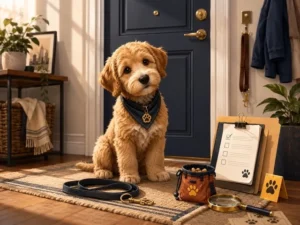
Step 1: Choose Your Puppy’s Potty Plan
Before training begins, decide where you want your puppy to potty. Puppies learn through repetition, so changing the rules too often can create confusion.
You have three main options.
Option 1: Outdoor-Only Potty Training
Outdoor-only training means your puppy learns from the start that bathroom business happens outside.
This can work well if you can take your puppy out frequently and have access to a safe, approved potty area.
To make it work:
Choose one outdoor potty spot.
Use the same exit route when possible.
Take your puppy there on leash.
Keep the trip boring until they go.
Use a simple cue like “go potty.”
Reward immediately after they finish.
That last clue is critical. AVSAB explains that potty rewards need to happen immediately after the puppy goes, not after returning indoors, or the puppy may not connect the treat with the correct behavior. (avsab.org)
Reward at the scene of the solved case, detective.
Option 2: Indoor Potty Training
Indoor potty training uses pee pads, washable pads, artificial turf, real grass patches, or another designated indoor potty area.
This may help if:
You live in a high-rise.
Your puppy is very young.
Outdoor access is slow or unsafe.
Weather is extreme.
You work outside the home.
Your veterinarian recommends avoiding shared dog areas temporarily.
VCA recommends choosing an appropriate toileting area and bringing the puppy there consistently when it is time to go, whether that area is outdoors or an indoor option like a pad. (VcaCanada)
The key is making the indoor potty spot obvious. It should be one specific location, not “anywhere near the kitchen, unless the moon is full.”
Option 3: Hybrid Training
Hybrid training means your puppy mostly goes outside but has an indoor emergency option.
This can be useful for apartment life, especially in high-rises or during early puppyhood. The risk is confusion. Some puppies may struggle to understand why a pee pad is allowed but the bath mat is apparently a scandal.
To reduce confusion:
Keep the indoor potty in one place.
Use a distinct surface, such as turf or grass.
Reward correct potty trips every time.
Do not let your puppy roam freely and choose random spots.
Gradually reduce indoor potty access if your goal is outdoor-only training.
Hybrid training is not failure. It is logistics.
Step 2: Set Up Your Apartment Potty Station
Before the first puddle appears, create your puppy potty headquarters.
Keep these supplies ready:
Leash and harness
Treats
Poop bags
Crate, playpen, or baby gate
Pee pads or grass patch, if using
Enzymatic cleaner
Paper towels or washable cloths
Slip-on shoes
Keys or building fob
Weather gear
A simple potty tracker
Apartment potty training depends on speed. When your puppy wakes up, you do not want to start searching for the leash like a detective who misplaced the magnifying glass.
Use a Crate, Pen, or Gated Area
Puppies should not have full apartment access during early potty training. Too much freedom creates too many opportunities for secret puddles.
The ASPCA recommends supervising dogs closely during housetraining and limiting their access to areas where you can see them. As training improves, you can slowly expand their space. (ASPCA)
A crate, playpen, or gated puppy-safe area helps when you cannot supervise directly. This is not punishment. It is management.
Think of your apartment in zones:
Green zone: Puppy recently pottied and is supervised.
Yellow zone: Puppy is awake and due for another potty break soon.
Red zone: Puppy just woke up, ate, drank, played, or started sniffing.
A red-zone puppy should not be roaming the living room unsupervised. That is how rugs become evidence.
Step 3: Follow a Puppy Potty Schedule
Young puppies need frequent potty breaks. A schedule helps you act before your puppy has an accident.
Take your puppy to the potty spot:
First thing in the morning
After naps
After meals
After drinking water
After play
After training sessions
After excitement or visitors
Before bedtime
During the night, if needed
Any time they sniff, circle, wander, squat, or suddenly disengage
The ASPCA lists sniffing, circling, and stiff-legged walking as common pre-potty signs and recommends getting the dog to the potty area quickly when these signs appear. (ASPCA)
In an apartment, “quickly” means before the elevator betrays you.
Sample Apartment Puppy Potty Schedule
Every puppy is different, but this schedule gives you a starting point.
Morning
Wake up → potty immediately
Breakfast → potty 10–20 minutes later
Play or training → potty again
Nap in crate or pen
Midday
Wake from nap → potty
Lunch, if age-appropriate → potty afterward
Supervised play → potty before resting
Evening
Arrive home → potty
Dinner → potty afterward
Calm play → potty
Final bedtime potty trip
Overnight
Very young puppies may need one or more overnight potty breaks. Keep these quiet and boring: out, potty, reward, back to sleep.
No midnight social hour. No lobby exploration. No suspicious leaf investigation.
Step 4: Master the Apartment Exit Strategy
This is where apartment potty training becomes its own special case file.
Your puppy may be able to hold it for another minute, but can they hold it through the leash clip, door lock, hallway, elevator delay, and neighbor who wants to say hello?
Maybe. Maybe not.
Make your exit routine fast.
Keep a “potty launch station” by the door with leash, treats, poop bags, keys, shoes, coat, and cleaning wipes. When the sniffing starts, you should be ready to move.
For very young puppies, consider the scoop and go method: carry them from the crate or pen to the outdoor potty spot. This can prevent hallway, stairwell, and elevator accidents.
Use this especially:
First thing in the morning
After naps
After meals
When your puppy is already sniffing
When elevators are slow
When the lobby has rugs or tempting corners
As your puppy gains bladder control, you can transition to walking calmly on leash.
Step 5: Reward the Right Behavior Immediately
When your puppy potties in the correct spot, reward like the case has been solved.
Here is the sequence:
Take your puppy to the potty spot.
Stand quietly.
Use your cue, such as “go potty.”
Wait.
When your puppy finishes, say “yes!”
Give a treat immediately.
Then offer praise, sniffing, or a short walk.
Do not wait until you get back upstairs. AVSAB notes that rewarding after returning indoors may accidentally reward coming back inside instead of pottying outside. (avsab.org)
Keep treats with you. In your pocket. At the potty spot. Ready for justice.
How Long Can a Puppy Hold It?
A common guideline is the “month-plus-one” rule: take your puppy’s age in months and add one to estimate the maximum number of hours they may be able to hold it. For example, a 3-month-old puppy may be able to hold it for about four hours. (American Kennel Club)
But this is a rough maximum, not a goal. Many puppies need to go more often, especially when awake, active, excited, or very small. AKC also notes that young puppies and toy breeds may need hourly potty opportunities when possible. (American Kennel Club)
For apartment living, assume your puppy needs to go sooner than the chart says.
Should You Use Pee Pads in an Apartment?
Pee pads are a tool. They are not good or bad by themselves. Their success depends on how consistently you use them.
Pee pads may help when:
Your puppy is very young.
You live several floors up.
Outdoor access takes too long.
The weather is severe.
You need an emergency backup.
Your vet recommends temporary caution around shared dog spaces.
Pee pads may create problems when:
Your puppy confuses them with rugs or bath mats.
The pads move around the apartment.
Your puppy has too much freedom.
The final goal is outdoor-only training but there is no transition plan.
To transition from pads to outside, move the pad closer to the door over time, take your puppy outside when they usually use the pad, use the same potty cue, and reward outdoor potty trips especially well.
The goal is to make outside feel like the next clue, not a totally new mystery.
What to Do About Accidents
Accidents happen. They are not proof that your puppy is stubborn, sneaky, or plotting against your security deposit.
They are information.
When your puppy has an accident:
Stay calm.
Do not yell.
Do not punish.
Do not rub their nose in it.
Clean thoroughly.
Adjust the schedule or supervision plan.
Punishment can make puppies afraid to potty in front of you, which makes training harder. You want your puppy to feel safe going near you so you can reward the right location.
If you catch your puppy in the act, calmly interrupt with “oops,” guide or carry them to the potty spot, and reward if they finish there.
If you find the accident later, just clean it. Your puppy will not connect your reaction to something they did earlier.
Then investigate:
Did they just wake up?
Did they eat or drink recently?
Was playtime too long?
Were they unsupervised?
Did they sniff or circle?
Was the trip outside delayed?
Did the pad move?
Was the rug too tempting?
Every accident is a clue for preventing the next one.
Clean With an Enzymatic Cleaner
Puppies use scent to decide where to potty. If an accident spot still smells like a bathroom, they may return to the scene.
Use an enzymatic cleaner made for pet messes and follow the product directions. Regular cleaners may remove the visible mess but leave behind odor your puppy can still detect.
For early potty training, consider removing rugs and bath mats temporarily. Soft surfaces are suspicious characters in this investigation.
How to Potty Train a Puppy While Working Full-Time
Most young puppies cannot be crated for a full workday without a potty break. The month-plus-one rule gives a rough maximum holding estimate, but it should not be used to push a puppy past what they can comfortably manage. (American Kennel Club)
If you work outside the home, consider:
A midday dog walker
A trusted neighbor or friend
Coming home at lunch
Puppy daycare when age-appropriate and vet-approved
A playpen with a separate indoor potty area
A grass patch or pee pad as temporary management
If your puppy has no realistic chance to reach the right potty spot, they will learn that accidents are normal. Set up the day so success is possible.
Common Apartment Potty Training Problems
My puppy pees in the hallway or elevator.
The trip is probably too long for your puppy’s current bladder control. Take more frequent breaks, carry your puppy during urgent times, and prep your supplies before opening the crate.
My puppy uses pee pads but will not go outside.
Outside may be distracting or unfamiliar. Take your puppy out when they usually use the pad, use the same cue, bring a lightly scented pad outside temporarily, and reward outdoor success generously.
My puppy keeps peeing on rugs.
Rugs may feel too much like pads, or old odor may remain. Remove rugs temporarily, clean with an enzymatic cleaner, supervise more closely, and limit freedom.
My puppy cries in the crate.
Your puppy may need to potty, may be lonely, or may not be fully crate-trained yet. Check whether they recently pottied and whether crate time is age-appropriate. VCA recommends consulting a veterinarian if a dog shows distress signs in the crate, such as persistent vocalization, salivation, escape attempts, or inability to settle. (VcaCanada)
How Long Does Apartment Puppy Potty Training Take?
Many puppies improve within a few weeks, but full reliability can take months.
The timeline depends on age, size, health, routine, previous habits, supervision, and how consistently you reward the right behavior.
Beware of promises like “potty train your puppy in seven days.” In the first week, the goal is not perfection. The goal is fewer accidents, clearer patterns, and better timing.
One dry hallway trip counts.
One successful post-nap potty counts.
One correctly rewarded outdoor pee counts.
That is how the mystery gets solved.
Apartment Puppy Potty Training Checklist
Choose outdoor, indoor, or hybrid training.
Pick one consistent potty spot.
Keep leash, treats, bags, and keys by the door.
Use a crate, pen, or gated area when you cannot supervise.
Take your puppy out after sleep, meals, water, play, and excitement.
Watch for sniffing, circling, wandering, and sudden disengagement.
Carry young puppies through hallways if needed.
Reward immediately after potty success.
Clean accidents with enzymatic cleaner.
Track patterns for one week.
Expand apartment freedom slowly.
Call your vet if accidents seem sudden, painful, bloody, or health-related.
⚠️ When Should You Call the Vet?
Most puppy accidents are normal training issues, but some clues deserve professional attention.
Call your veterinarian if your puppy has sudden accidents after doing well, frequent urination, straining, signs of pain, blood in urine or stool, diarrhea, vomiting, excessive thirst, lethargy, or accidents that do not improve with a consistent plan.
Potty training can solve a training problem. It cannot solve a medical one.
The Final Verdict
Learning how to potty train a puppy in an apartment is not about having the perfect puppy or the perfect elevator timing. It is about reading the clues early.
Puppy wakes up? Potty.
Puppy eats? Potty.
Puppy plays? Potty.
Puppy sniffs the rug with suspicious intensity? Definitely potty.
With a clear routine, quick exits, immediate rewards, careful supervision, and compassionate cleanup, your puppy will start to understand the rules.
One day, the hallway will be dry, the rug will be innocent, and your puppy will have cracked the code.
Case closed.
FAQs
How often should I take my puppy out in an apartment?
Very young puppies may need potty breaks every 30–60 minutes when awake, plus after naps, meals, water, play, and excitement. The month-plus-one rule can estimate a rough maximum holding time, but many puppies need more frequent breaks. (American Kennel Club)
Can you potty train a puppy in an apartment without pee pads?
Yes. Many apartment puppies can learn outdoor-only potty training. You will need frequent trips outside, a fast exit routine, close supervision, and immediate rewards.
Are pee pads bad for puppy potty training?
Not necessarily. Pee pads can help in apartments, but they may confuse some puppies if the final goal is outdoor-only pottying. Use them consistently and transition gradually.
Should I carry my puppy outside to potty?
For young puppies, yes, carrying can help prevent hallway, stairwell, elevator, and lobby accidents. As your puppy gains bladder control, you can transition to walking on leash.
What should I do if my puppy has an accident inside?
Stay calm, clean the area with an enzymatic cleaner, and adjust your schedule or supervision. If you catch your puppy in the act, calmly interrupt and move them to the correct potty spot.
How long does it take to potty train a puppy in an apartment?
Many puppies improve within a few weeks, but full reliability can take several months. Age, size, health, consistency, and apartment logistics all affect the timeline.
When should I call a vet about potty accidents?
Call your veterinarian if accidents are sudden, frequent, painful, bloody, paired with excessive thirst, or not improving despite a consistent training plan.